
A $30,000 discount can still require more cash


SQM Research reported that national residential property listings rose 12.4% in July 2026 to 278,984 dwellings, 22.8% above July 2025. More available stock may give some buyers more choice and negotiating room, but the agreed price and the lender's property valuation remain separate parts of the finance decision.
A successful discount does not guarantee that the lender will adopt the contract price as its value or advance the amount originally planned. If the lender valuation is lower, the loan-to-value ratio can rise and the buyer may need to contribute more cash—even though the negotiated price is below the advertisement.
Why negotiation and valuation are separate
The contract price is what the buyer agrees to pay. The bank valuation is the value the lender uses to assess its security and calculate LVR. APRA requires prudently conservative property valuation for regulated lenders, while lender guidance explains that a lower relevant value may be used when the purchase price and valuation differ.
This does not mean every negotiated purchase will receive a low valuation. It means the valuation, acceptable LVR, property type, location and the borrower's serviceability still need to be checked before treating a discount as fully funded.
Worked example: $720,000 contract and $690,000 valuation

Advertised price: $750,000. Agreed contract price: $720,000. At an illustrative 80% LVR based on the contract price, the planned loan is $576,000 and the planned cash contribution is $144,000.
If the lender values the property at $690,000 and lends 80% of that valuation, the illustrative loan becomes $552,000. The cash required toward the $720,000 price becomes $168,000—$24,000 more than the original plan.
The extra cash arises from the valuation shortfall, not from negotiating the price. This example excludes transfer duty, conveyancing, inspections, lender fees, mortgage insurance and other costs. An 80% LVR is an illustration, not a universal product limit, lender quote or approval.
Four checks before making an offer
1. Review comparable sales — use recent, genuinely comparable transactions rather than the advertised price alone.
2. Confirm valuation timing — ask when the lender can assess the specific property and whether a desktop or full valuation may be required.
3. Review contract protection — ask your conveyancer or solicitor how valuation and finance conditions operate for the contract and state involved.
4. Keep a cash buffer — allow for a valuation gap, buying costs and any repairs without using funds reserved for ongoing repayments.
Valuation and finance terms
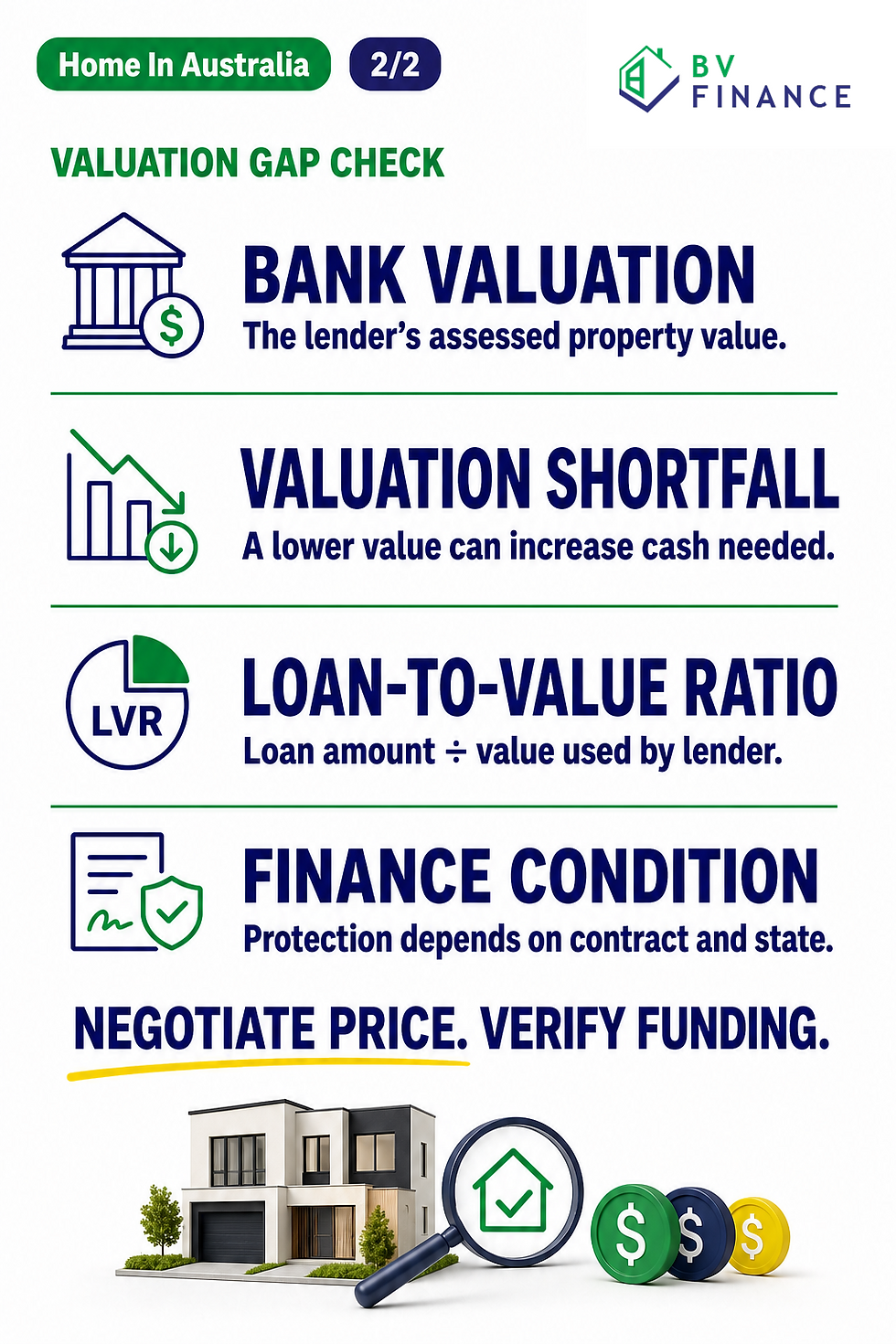
Bank Valuation — the lender's assessed value of the property used in its security and lending decision.
Valuation Shortfall — the gap when the lender valuation is below the agreed contract price, potentially increasing the buyer's cash contribution.
Loan-to-Value Ratio (LVR) — the loan amount divided by the property value used by the lender.
Finance Condition — a contract condition whose protection and operation depend on the contract wording and applicable state law.
Bottom line
More listings can create choice, and negotiation can reduce the purchase price. Neither replaces the finance check. Before committing, test the lender valuation, acceptable LVR, required cash, buying costs, rental-income treatment and repayment capacity together.
Sources
SQM Research — National Property Listings, July 2026
Moneysmart — Buying a house
General information only. This is not financial advice. Loan options and eligibility depend on your personal income, liabilities, assets and lender assessment criteria.


Comments