
Quieter open homes do not remove property risk


A quieter open home can give a buyer more time to look, ask questions and compare options. The incomplete assumption is that fewer people automatically make the property safer or easier to finance. Attendance, building condition, contract risk and lender valuation are separate questions.
The practical decision is whether the property still fits your verified finance, cash buffer and risk tolerance after independent checks—not whether the hallway felt less crowded on Saturday.
What the latest open-home data shows
Ray White data reported by ABC covered about 13,000 open homes a week. Average attendance fell from 3.6 a year earlier to 2.1 by early July, a decline of more than 40%. Attendance had been broadly steady during the most recent month, and results varied between cities.
Separate Cotality data reported by ABC showed buyers across the combined capital cities paying up to 3.6% below the original asking price for private-treaty purchases over the previous three months. That may indicate more negotiating room in parts of the market; it is not a promised discount for a particular home.
Worked example: price discount versus valuation

Assume a property is advertised at $750,000 and the buyer negotiates 3% lower. The purchase price becomes $727,500.
If the lender values the property at $715,000 and the selected product allows a maximum 90% LVR, the illustrative loan limit is $643,500. Cash toward the price becomes $84,000, compared with $72,750 for a 10% deposit on the purchase price—a difference of $11,250.
This example excludes transfer duty, legal fees, lender fees, lenders mortgage insurance, repair costs and lender-specific policy. A lower negotiated price can help, but it does not guarantee the valuation, product limit or final approval.
Three checks before an offer
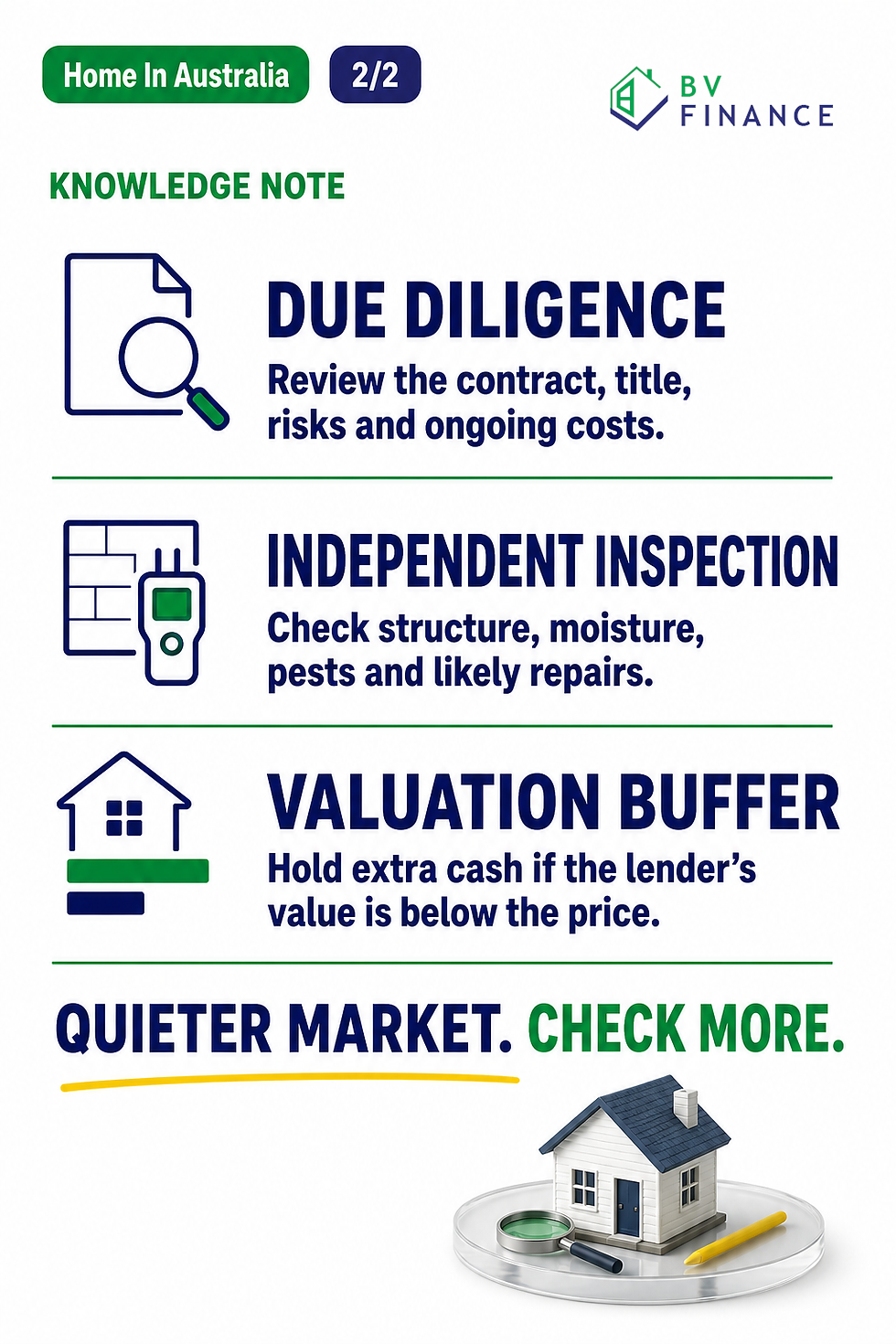
Due diligence — review the contract, title information, restrictions, owners-corporation material where relevant and likely ongoing costs with appropriate professional help.
Independent inspection — a qualified building and pest professional can identify defects, moisture, pests, unsafe work and likely repair priorities that are not obvious during a short viewing.
Valuation buffer — keep extra cash available in case the lender values the property below the agreed price or applies a lower acceptable LVR.
Auction and private sale are not interchangeable
Moneysmart notes that an auction purchase has no cooling-off period and is not subject to finance or building and pest inspection. Private-sale offers may be conditional, depending on the contract. Rules and rights vary by state, territory and sale method, so obtain legal advice before bidding or making an unconditional offer.
Weekend buyer checklist
• Compare evidence — use recent like-for-like settled sales, not only the original asking price.
• Inspect independently — arrange building and pest checks early enough for the sale method.
• Review the contract — ask a solicitor or conveyancer to explain the property-specific terms and disclosures.
• Confirm finance room — give the property address and sale method to your broker or lender and keep cash for valuation and repair surprises.
Bottom line
Lower attendance can create time, not certainty. Use that time to compare the property, inspect it independently, review the contract and confirm how a lower lender valuation would affect your cash before committing.
Sources
ABC News — Attendance at open homes has slumped
Moneysmart — Buying a house
Consumer Affairs Victoria — Inspect properties before you buy
General information only. This is not financial advice. Loan options and eligibility depend on your personal income, liabilities, assets and lender assessment criteria.



Comments